Introduction to Autonomous Fish Farms
The aquaculture industry stands at the precipice of a technological revolution. As global demand for seafood continues to surge, driven by population growth and changing dietary preferences, traditional fish farming methods face mounting pressure to increase efficiency and sustainability. Autonomous fish farms, powered by cutting-edge robotics and artificial intelligence, represent a transformative solution to these challenges. These innovative systems promise to reshape how we produce fish, reducing operational costs, minimizing environmental impact, and ensuring more consistent product quality.
The Current State of Aquaculture
Conventional fish farming has long relied on manual labor-intensive processes. Workers must monitor water quality parameters, distribute feed, manage disease outbreaks, and handle harvesting operations through hands-on intervention. This approach, while effective to a degree, presents significant limitations including:
- High operational labor costs
- Inconsistent monitoring and decision-making
- Environmental waste and pollution concerns
- Limited scalability for meeting global demand
- Vulnerability to disease spread and fish mortality
Robotics Technology in Aquaculture
Modern robotics technology has emerged as a game-changer for the aquaculture sector. Autonomous systems now perform tasks that were previously impossible or impractical, fundamentally changing farm operations:
Automated Feeding Systems
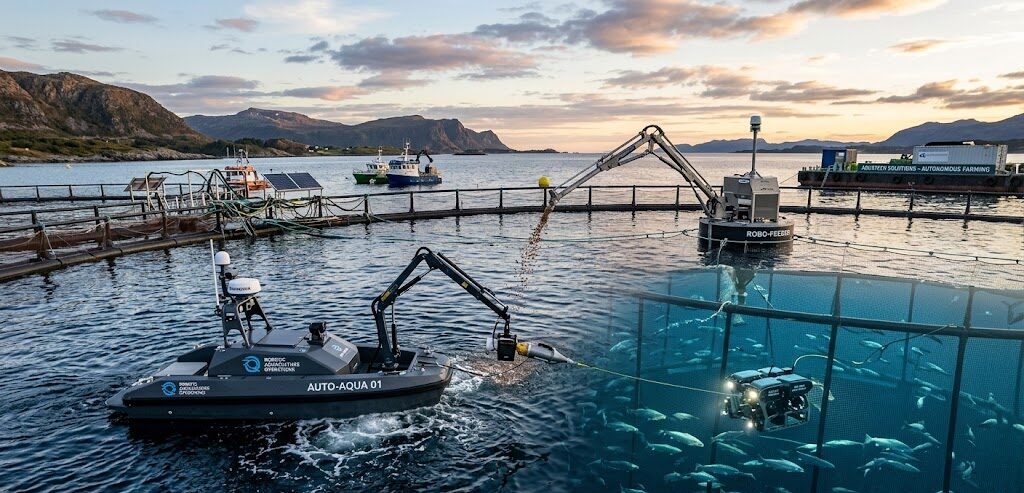
Robotic feeding mechanisms utilize computer vision and artificial intelligence to assess fish behavior and appetite levels in real-time. These systems dispense precise amounts of feed based on actual consumption patterns, reducing feed waste by up to 20 percent. This not only decreases operational costs but also minimizes uneaten feed that would otherwise degrade water quality and harm aquatic ecosystems.
Water Quality Monitoring
Autonomous underwater drones equipped with sophisticated sensor arrays continuously monitor critical water parameters including dissolved oxygen, pH levels, temperature, and ammonia concentration. These robotic systems transmit data instantaneously to central control systems, enabling immediate corrective actions before conditions deteriorate and threaten fish populations.
Disease Detection and Management
Advanced robotic systems employ machine learning algorithms to identify early signs of disease in fish populations. By analyzing behavioral patterns, physical abnormalities, and water chemistry indicators, these systems can alert operators to potential health crises before widespread infection occurs, significantly reducing mortality rates and the need for chemical treatments.
AI-Driven Decision Making
Artificial intelligence serves as the operational brain of autonomous fish farms. Machine learning algorithms process vast amounts of environmental and biological data to make real-time decisions that optimize farm performance. These systems learn from historical patterns and continuously improve their decision-making accuracy, adapting to changing conditions and unexpected challenges without human intervention.
Environmental Benefits
Autonomous fish farms deliver substantial environmental advantages over traditional operations:
- Reduced Chemical Usage: Precise monitoring enables farms to use only necessary treatments, minimizing chemical pollution in surrounding waters
- Optimized Feed Conversion: Intelligent feeding systems maximize nutrient efficiency while reducing waste and nutrient runoff
- Lower Carbon Footprint: Automated operations reduce unnecessary human transportation and energy consumption
- Improved Water Quality: Continuous monitoring ensures aquatic habitats surrounding farms remain healthier
Economic Impact and Cost Reduction
The financial benefits of autonomous fish farms are compelling. By automating labor-intensive processes, farms can reduce operational costs by 25 to 40 percent. Increased efficiency in feed utilization, improved harvest yields, and reduced disease-related losses contribute to significantly improved profit margins. Additionally, the ability to operate with minimal human oversight enables farms to function continuously, even during nights and weekends, maximizing productivity across all hours.
Scalability and Production Capacity
Autonomous systems unlock unprecedented scalability potential. A single operator can effectively manage multiple farms or substantially larger operations, previously requiring extensive teams. This scalability makes it economically feasible to establish fish farms in previously impractical locations, expanding global aquaculture capacity to meet growing seafood demand without compromising quality or environmental standards.
Challenges and Considerations
Despite their tremendous potential, autonomous fish farms face several hurdles to widespread adoption:
- Initial Capital Investment: High upfront costs for robotic systems and infrastructure present barriers for smaller operations
- Technical Expertise Requirements: Operating and maintaining autonomous systems demands specialized knowledge and training
- Regulatory Framework Development: Governments must establish clear guidelines and standards for autonomous aquaculture operations
- Cybersecurity Concerns: Connected systems require robust protection against potential digital threats
- Integration with Existing Operations: Retrofitting traditional farms with autonomous technology presents practical challenges
Future Prospects and Innovations
The trajectory of autonomous aquaculture technology points toward increasingly sophisticated innovations. Emerging developments include blockchain-based supply chain tracking for transparency and food safety, advanced genetic monitoring of fish populations, predictive analytics for disease outbreak prevention, and integration with renewable energy systems for sustainable operations. As technology matures and costs decrease, autonomous fish farms will become increasingly accessible to operations of all sizes.
Conclusion
Autonomous fish farms represent a paradigm shift in aquaculture, combining robotics, artificial intelligence, and data analytics to address industry-wide challenges. By automating complex processes, these systems enhance productivity, reduce environmental impact, and improve economic viability. As the world population approaches 10 billion people and seafood demand continues to escalate, autonomous aquaculture technologies will play an increasingly critical role in ensuring global food security while maintaining environmental responsibility. The future of fish farming is not just more efficient—it is fundamentally more intelligent.