Revolutionary Monitoring from Above
The world’s oceans face unprecedented pressure from overfishing and climate change, making accurate fish stock assessment critical for sustainable marine resource management. Satellite technology has emerged as a game-changing solution, enabling scientists and fisheries managers to monitor fish populations and fishing activities from space with unprecedented accuracy and coverage.
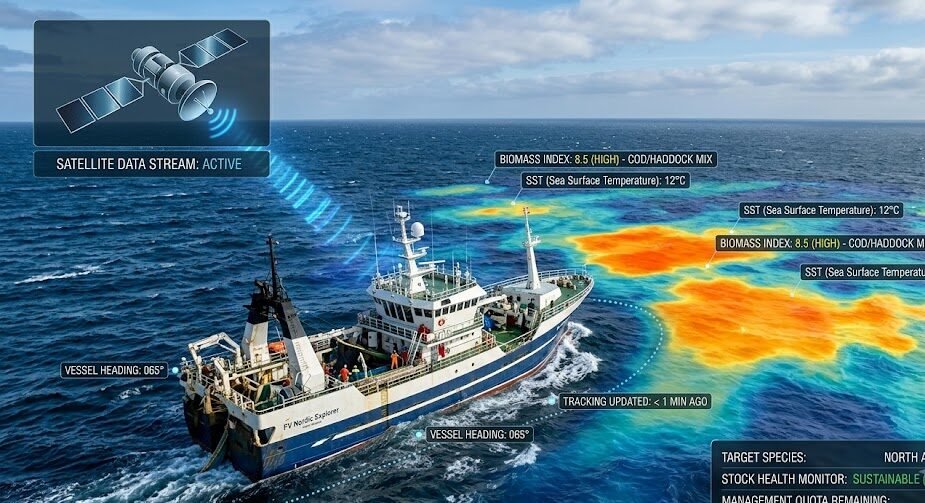
This innovative approach combines advanced satellite imaging with artificial intelligence and machine learning algorithms to detect fishing vessels, estimate catch volumes, and track fish migration patterns across vast ocean territories that would be impossible to monitor using traditional methods alone.
How Satellite Technology Works for Fish Stock Monitoring
Modern satellite systems employ multiple data collection methods to track fish stocks effectively:
- Synthetic Aperture Radar (SAR): Penetrates cloud cover and darkness to detect fishing vessels and map ocean activity in real-time, regardless of weather conditions or time of day
- Optical Imaging: Captures high-resolution images of vessel movements and fishing patterns, providing visual confirmation of fishing activities
- Automatic Identification System (AIS): Tracks vessel locations, speeds, and routes, offering crucial data on fishing intensity and fleet movements
- Environmental Monitoring: Measures sea surface temperature, chlorophyll levels, and ocean currents that influence fish distribution and behavior
These complementary technologies work together to create a comprehensive picture of fishing activities and marine ecosystems, enabling more informed decisions about sustainable fisheries management.
Global Impact and Benefits
The implementation of satellite-based fish stock monitoring systems has delivered significant benefits to ocean health and food security globally:
- Enhanced detection and prevention of illegal, unreported, and unregulated (IUU) fishing activities
- Improved accuracy in estimating fish populations and stock health
- Data-driven policy-making for fisheries management and conservation efforts
- Support for sustainable fishing practices that balance economic needs with environmental protection
- Real-time alerts to authorities regarding unauthorized fishing in protected marine areas
Developing nations particularly benefit from this technology, as it provides cost-effective monitoring capabilities that were previously accessible only to wealthy countries with established maritime enforcement infrastructure.
Challenges and Future Developments
Despite its promise, satellite-based fish stock monitoring faces several challenges. High-resolution satellite imagery remains expensive, and data interpretation requires specialized expertise. Additionally, some fishing vessels employ tactics to evade detection, such as disabling tracking systems or operating in areas with limited satellite coverage.
The future of this technology lies in continued innovation and international collaboration. Emerging developments include:
- Integration with blockchain technology for transparent supply chain tracking
- Advanced machine learning models that improve detection accuracy and reduce false positives
- Increased accessibility through cost-sharing arrangements and international partnerships
- Development of smaller, more frequent satellite constellations for continuous monitoring
- Combined use of satellite data with underwater acoustic monitoring systems
Supporting Global Food Security
With over three billion people depending on marine and coastal biodiversity for their livelihoods, and fish providing essential protein to billions more, effective fish stock management is crucial for global food security. Satellite technology enables the sustainable harvesting of fish resources while protecting vulnerable ecosystems from collapse.
By providing transparent, objective data on fish populations and fishing activities, satellite systems help establish science-based catch limits and enforce international fishing agreements. This technological advancement supports the United Nations Sustainable Development Goals, particularly those addressing poverty reduction, food security, and marine conservation.
Conclusion
Satellite technology represents a transformative approach to fish stock monitoring, offering unprecedented visibility into ocean activities and marine resource health. As this technology continues to evolve and become more accessible, it will play an increasingly vital role in ensuring the sustainable management of fish stocks for future generations. Through continued investment in satellite systems and supporting technologies, the global community can better protect our oceans while maintaining the fisheries that support billions of people worldwide.